
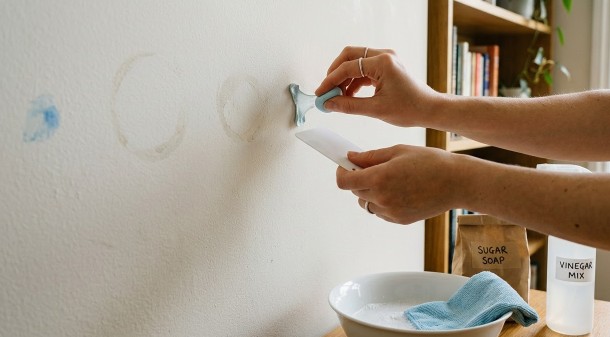
- Why Does Blu Tack Leave Those Annoying Greasy Marks?
- Does Sugar Soap Remove Blu Tack Marks?
- How To Remove Blu Tack From Walls Without Peeling The Paint?
- How Can You Get Rid Of Hardened, Old Blu Tack Residue?
- How To Remove Blu Tack Stains From Wall UK Homes Often Have?
- What are the Hacks To Get Blu Tack Off Walls When It's Stubborn?
- Can You Paint Straight Over Blu Tack Stains?
- What To Use Instead Of Blu Tack On Walls?
- Conclusion
- What are the FAQ About How To Remove Blu Tack From Walls?
I’ve spent over fifteen years as a professional decorator in the UK, and if there is one thing that haunts landlords and tenants alike, it’s the sight of greasy blue circles left behind on a freshly painted wall.
I’ve seen countless walls ruined by people trying to “pick” at old adhesive—here is the manual-free, expert-tested way I remove Blu Tack and its stains in minutes without losing your housing deposit.
⚡ The Short Answer: How to Remove Blu Tack From Walls?
If you’re in a hurry to save your paintwork and protect your deposit, follow these expert steps:
- •
The “Roll and Dab” Method: Use a fresh piece of warm tack to pull away residue rather than picking at it. - •
Apply Heat: Use a hairdryer on a low setting for 20 seconds to soften hardened tack before removal. - •
Lift the Grease: Use Sugar Soap or a 50/50 white vinegar mix to remove oily “bleed” marks. - •
Seal the Stain: For permanent shadows, use a stain-blocking primer (like Zinsser B-I-N) before touching up.
Why Does Blu Tack Leave Those Annoying Greasy Marks?
As a decorator, I often explain to my clients that Blu Tack is essentially a mixture of synthetic rubber and mineral oil. Over time, especially in warm rooms or on porous surfaces, that oil “bleeds” into the paint.
Modern UK matt emulsions, which are highly popular for their flat finish, are unfortunately the most vulnerable. Unlike silk or eggshell paints, matt paint is porous, meaning it sucks up the Blu Tack oils like a sponge, creating those permanent-looking dark spots.
Does Sugar Soap Remove Blu Tack Marks?
One of the most frequent questions I get during a “refresh” job is: Does sugar soap remove Blu Tack marks? The answer is a resounding yes, but with a caveat.
Sugar soap is a mild detergent specifically designed to cut through grease and tobacco film before painting. Since Blu Tack marks are oil-based, sugar soap is my go-to “hack” for cleaning the wall before I even think about touching up the paint.
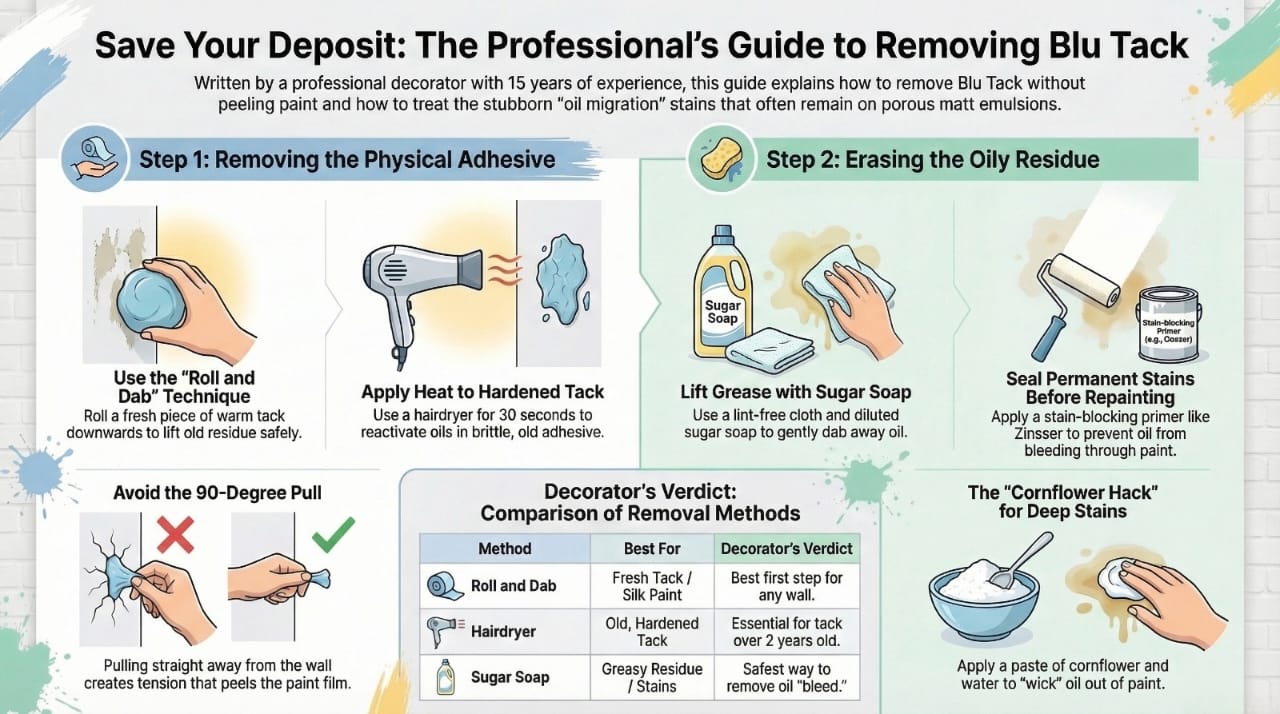
Comparison Table: Removal Methods vs. Surface Types
| Method | Best For | Risk Level | Decorator’s Verdict |
|---|---|---|---|
| Roll and Dab | Fresh Blu Tack / Silk Paint | Low | Best first step for any wall. |
| The Hairdryer | Old, Hardened Tack | Medium | Essential for 2+ year-old tack. |
| Sugar Soap | Greasy Residue / Stains | Low | Safest way to remove the oil “bleed.” |
| White Spirit | Stubborn Residue on Wood | High | Use with caution; can dissolve paint. |
| Magic Eraser | Scuffs / Non-Porous walls | Medium | Can leave “shiny patches” on matt walls. |
How To Remove Blu Tack From Walls Without Peeling The Paint?
The mistake most people make is trying to pull the tack away at a 90-degree angle. This creates tension that pulls the paint film away from the plaster.
Instead, use the “Roll and Dab” technique:
- Take a fresh, clean piece of Blu Tack and warm it up in your hands until it’s stretchy.
- Press it firmly against the edge of the tack on the wall.
- Slowly “roll” the fresh tack downwards. The adhesive property of the new tack will pull the old tack away from the wall without tugging on the paint.
How Can You Get Rid Of Hardened, Old Blu Tack Residue?
When Blu Tack has been on a wall for years, it dries out and becomes brittle. If you try to roll it, it will simply snap, or worse, take the top layer of paint with it.
Pro-Tip 1: Use a hairdryer on a medium heat setting. Hold it about 10cm away from the tack for 30 seconds. This softens the mineral oils and reactivates the adhesive, making it pliable enough to “roll and dab.” Be careful not to get too close, or you might cause the paint to blister.
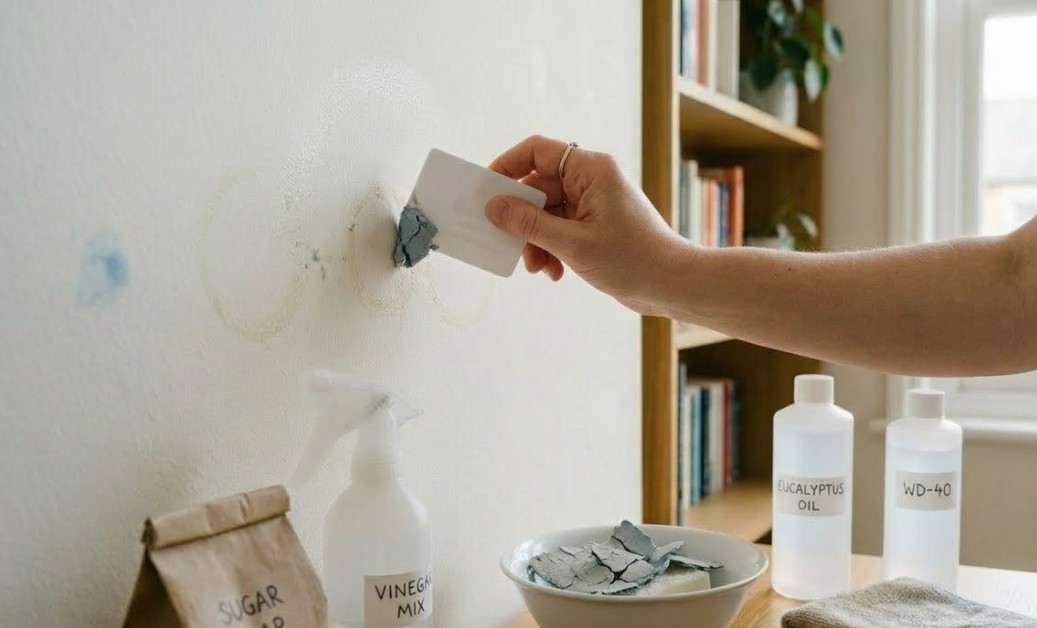
How To Remove Blu Tack Stains From Wall UK Homes Often Have?
If you’ve removed the tack but the dark mark remains, you are dealing with “oil migration.” This is the primary reason tenants lose their deposits.
- The Sugar Soap Method: Mix a small amount of liquid sugar soap with warm water. Using a lint-free cloth, gently dab the stain. Do not scrub, as this will create a “shiny” spot on matt paint.
- The Cornflower Hack: For very deep oil stains on light-coloured walls, I often recommend making a thick paste of cornflower (or talcum powder) and a tiny drop of water. Apply it to the stain, let it dry for two hours, then brush it off. The powder “wicks” the oil out of the paint.
Pro-Tip 2: If you are dealing with Silk or Eggshell paint, a simple mix of white vinegar and water on a microfibre cloth works wonders for a streak-free finish that lifts the grease instantly.
What are the Hacks To Get Blu Tack Off Walls When It’s Stubborn?
If the standard methods fail, here are two industry secrets I use:
- The “White Tack” Trick: If you have white walls, always use White Tack instead of Blue. It doesn’t contain the blue dye that can occasionally stain.
- Citrus Cleaners: A tiny drop of a citrus-based adhesive remover (like Goo Gone) on a cotton bud can dissolve the tack. However, you must immediately wash the area with soapy water to prevent the cleaner itself from staining.
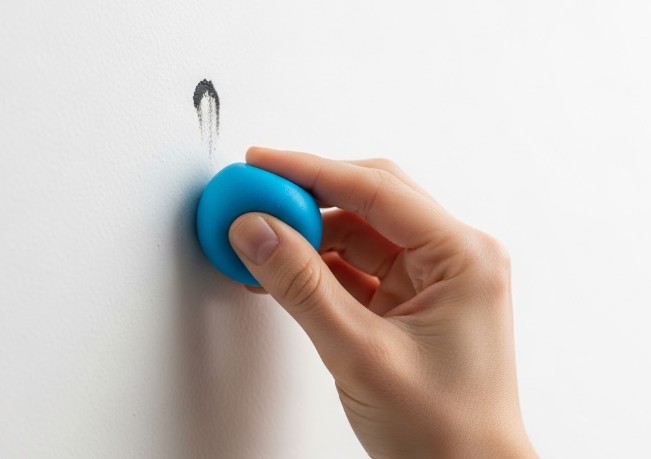
Can You Paint Straight Over Blu Tack Stains?
No. I cannot stress this enough. If you paint directly over a Blu Tack oil stain with standard emulsion, the oil will eventually “bleed” through the new layer. You will end up with the same dark spot six months later.
Pro-Tip 3: If the stain is permanent, you must use a Stain-Blocking Primer. In the UK, I always keep a tin of Zinsser B-I-N or Bulls Eye 1-2-3 in my van. A quick dab of this “seals” the oil. Once dry, you can paint over it with your topcoat, and the mark will never return.
What To Use Instead Of Blu Tack On Walls?
To avoid these headaches entirely, I recommend my clients look at alternatives that are kinder to British plasterwork:
- Command Strips: These use a stretch-release adhesive that leaves zero residue.
- Washi Tape: Great for posters; the adhesive is much weaker and doesn’t contain mineral oils.
- Hook and Loop (Velcro) Pads: Better for heavier items, though they require more care during removal.
Conclusion
Knowing How To Remove Blu Tack From Walls is an essential skill for any UK renter or homeowner. By using the “roll and dab” method combined with the heat of a hairdryer, you can save your paintwork from unnecessary damage.
If you are left with those dreaded oily shadows, remember that Sugar Soap is your best friend for lifting the grease before it becomes a permanent feature.
Follow these professional steps, and you’ll keep your walls looking pristine and your deposit safely in your pocket. Happy decorating!
What are the FAQ About How To Remove Blu Tack From Walls?
1. Does WD-40 remove Blu Tack?
While WD-40 will dissolve the adhesive, I strongly advise against it on painted walls. WD-40 is an oil itself; you are essentially replacing one oil stain with a much larger, more difficult one.
2. Will a Magic Eraser take the paint off?
On silk paints, a Magic Eraser is fine. On matt emulsion, it acts like very fine sandpaper. It will remove the mark but might leave a “burnished” or shiny patch that is visible when the light hits it.
3. How long do Blu Tack stains last?
Unfortunately, oil stains are permanent unless they are chemically lifted (with sugar soap/cleaning agents) or sealed with a primer.
4. Can you use Blu Tack on freshly painted walls?
Never. You must wait at least 4 weeks for the paint to “cure” fully. If the paint is still “outgassing,” the Blu Tack will bond to it permanently.
Lead Technical Researcher
Kanimozhi BV
Kanimozhi is a professional decorator, home improvement and diagnostics specialist at Hello Magazine UK. With a background in technical research, she bridges the gap between professional trade standards and practical DIY solutions. From troubleshooting complex appliance error codes to ecological pest control and modern interior design, Kanimozhi provides evidence-based guides to help UK homeowners maintain safe, efficient, and beautiful living spaces.

Home Diagnostics and Technical Standards Specialist at Hello Mag. She provides high-level Expertise in appliance mechanics and scientific pest management, ensuring every guide follows strict safety protocols and manufacturer standards. As a leading Authority on technical home specs, Kanimozhi audits complex data to provide homeowners with the most accurate, verified, and reliable diagnostic solutions available.
0 Comments