

- Mouse Removal Timelines: DIY vs. Professional Intervention
- Why Does It Take So Long To Clear A Mouse Infestation?
- What Is The Realistic Day-By-Day Recovery Timeline?
- How Do You Know When The Mice Are Truly Gone?
- What Factors Slow Down The Removal Process?
- Who Is Responsible For Mice In A UK Rental Property?
- Conclusion: Reclaiming Your Home
- What are the FAQ About How Long Does It Take To Get Rid Of Mice?
I’ve spent years renovating Victorian terraces in London and Bristol, and if there is one thing I’ve learned the hard way, it’s that a single “scritch-scratch” in the skirting board at 2 AM is never just one mouse.
I once spent three weeks thinking a single snap trap behind the fridge would do the trick, only to realize I was dealing with a multi-generational family that had claimed my wall voids as their own. Getting rid of mice isn’t just about a trap; it’s about outsmarting a biological clock.
⚡The Short Answer: How Long Does It Take To Get Rid Of Mice?
For a minor infestation, it typically takes 1 to 3 weeks to achieve total eradication using a combination of professional-grade traps and entry-point sealing. However, if the nesting site is established within wall cavities, the process can take up to 5 or 6 weeks to ensure the entire breeding cycle is broken.
Mouse Removal Timelines: DIY vs. Professional Intervention
When you’re dealing with a UK home—especially older builds with suspended timber floors—the method you choose dictates your “freedom date.”
| Method | Time to First Catch | Time to Total Eradication | Success Rate |
|---|---|---|---|
| Basic DIY (Snap Traps) | 24–48 Hours | 4–6 Weeks | Moderate |
| Professional Pest Control | 12–24 Hours | 2–3 Weeks | High |
| Humane/Live Catch | 1–3 Days | 6+ Weeks (Relocation is key) | Low |
| Poison/Rodenticide | 3–7 Days | 3–4 Weeks | High (But risky for pets) |
Why Does It Take So Long To Clear A Mouse Infestation?
The biggest mistake I see homeowners make is assuming that catching one mouse means the job is done. To understand the timeline, you have to understand the “21-Day Rule.”
A female house mouse can produce a new litter every 21 days. If you kill the adults but miss the entry points or the nest, you are simply waiting for the next “crop” to mature.
Furthermore, the “5mm Rule” is the bane of UK property managers. If you can poke a standard Bic pen into a gap under a door or around a radiator pipe, a mouse can get through it.
Until every one of those gaps is plugged with wire wool or specialist sealant—a key step in our complete guide on how to get rid of mice in the house or you have utilised natural deterrents like those found in our list of what smells do mice hate— your “removal” timeline is actually an “infinite loop” of new mice arriving from the street or neighboring gardens.

What Is The Realistic Day-By-Day Recovery Timeline?
If you start a concerted effort today, here is what your next month will likely look like:
Days 1–3: The Disruption Phase
During the first 72 hours, you are gathering intelligence. You’ll place traps along the “smear marks” (the greasy trails mice leave along walls). You might actually see more activity initially because you’ve disrupted their safe routes.
Pro-Tip: Don’t set the traps on Night 1. Place them “unset” with bait (peanut butter is better than cheese) for 24 hours. Mice are “neophobic”—they fear new things. Let them eat for free once; they’ll be overconfident on Night 2 when you actually set the trigger.
Week 1: Population Reduction
This is when you’ll see the most “catches.” You are removing the boldest members of the colony. By day 7, the nighttime scratching should diminish significantly. This is also the time to do a “perimeter sweep” of your kitchen cabinets.
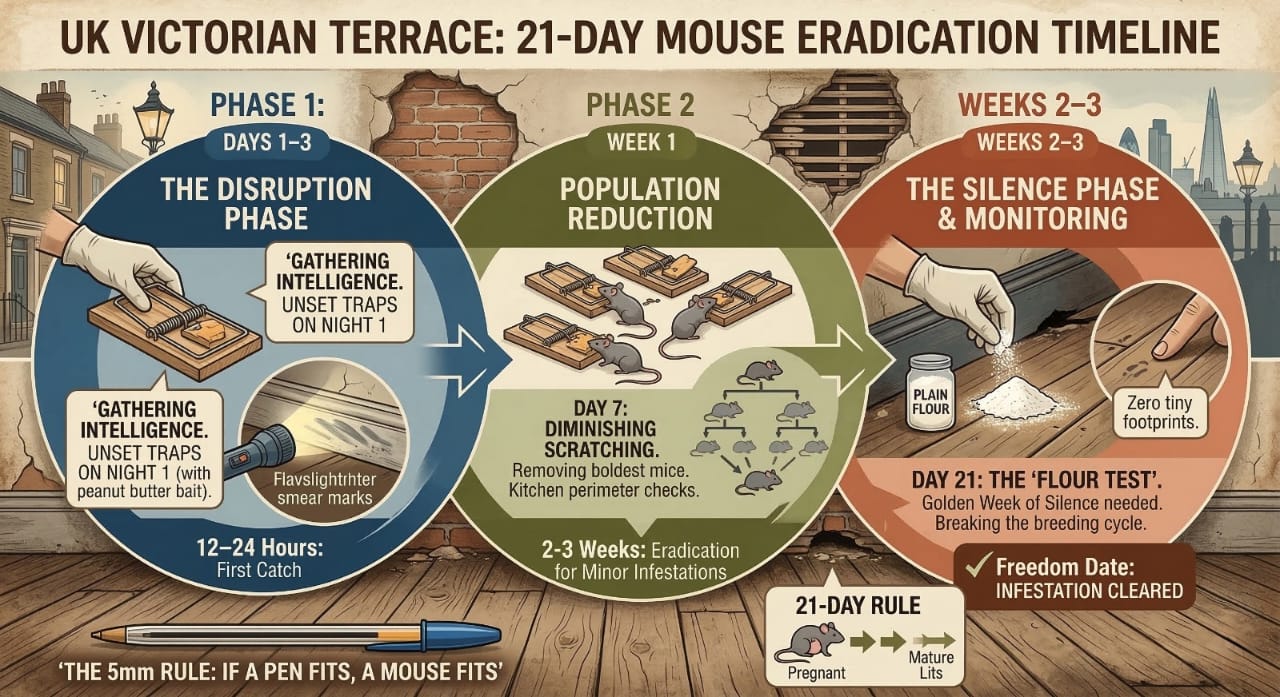
Weeks 2–3: The Silence Phase and Monitoring
This is the “danger zone” where most people stop. It’s been quiet for four days, so you pack away the traps. Don’t. This is usually when the juveniles or the “shy” mice begin to emerge.
You must keep the traps active through this entire period to ensure no survivors are left to restart the breeding cycle.
How Do You Know When The Mice Are Truly Gone?
The absence of noise isn’t proof; silence is just a sign they are being cautious.
The Flour Test (Pro-Tip): This is my go-to “Information Gain” trick that professionals use but rarely mention. Lightly dust a small amount of plain flour on the floor near your kickboards or under the sink at night. If there are no tiny footprints in the morning for three consecutive nights, you are likely in the clear.
Additionally, look for the “Golden Week of Silence.” If you have had zero new droppings, zero footprints in the flour, and zero noises for seven full days, you have successfully broken the infestation.
What Factors Slow Down The Removal Process?
- The Pet Food Trap: If you leave a bowl of kibble out for your cat or dog overnight, you are providing a 5-star buffet. Mice will ignore your traps because they have a safer, easier food source.
- Cluttered Lofts: In the UK, we love storing Christmas decorations in cardboard boxes. These are essentially “mouse hotels.” Until you switch to plastic “Really Useful” boxes, you are providing nesting material that shields them from your treatments.
- Adjoined Properties: If you live in a semi-detached or terraced house and your neighbor has an infestation they aren’t treating, your timeline will be much longer. Mice move through the joist gaps between houses with ease.

Who Is Responsible For Mice In A UK Rental Property?
If you are a renter, the timeline for removal often depends on how fast your landlord acts. Under the Homes (Fitness for Human Habitation) Act 2018, landlords are generally responsible for dealing with infestations unless they can prove the tenant’s lifestyle (e.g., extreme clutter or poor food hygiene) caused the problem.
If the mice are entering through structural defects—like a hole in the external brickwork or a faulty drain—it is 100% the landlord’s legal obligation to fix it. If they refuse to act, contact your local council’s Environmental Health department.
They can issue an improvement notice which usually speeds up the “professional intervention” timeline significantly.
Conclusion: Reclaiming Your Home
Getting rid of mice isn’t a weekend DIY project; it’s a three-week siege. By respecting the 21-day breeding cycle and using the “Flour Test” to verify your progress, you can ensure that once the scratching stops, it stays stopped. Seal the gaps, clear the crumbs, and stay vigilant. Your home belongs to you—not the rodents.
What are the FAQ About How Long Does It Take To Get Rid Of Mice?
1. Does one mouse mean an infestation?
Almost always, yes. Mice are social creatures. If you see one during the day, it usually means the nest is overcrowded and the “low-ranking” mice are being forced to forage while the others sleep.
2. Do ultrasonic repellers speed things up?
In my experience: No. While they might cause temporary annoyance, mice quickly habituate to the sound. I’ve seen mice nesting directly underneath an active ultrasonic plug-in. Spend that money on better traps and steel wool instead.
3. Can I sleep in a room with a mouse?
It is safe in the sense that they won’t attack you, but mice are incontinent—they urinate as they walk to mark trails. This can spread salmonella and hantavirus. If you have mice in the bedroom, it’s time to escalate to professional BPCA-accredited help immediately.
Kanimozhi BV
Kanimozhi is a home improvement and diagnostics specialist at Hello Magazine UK. With a background in technical research, she bridges the gap between professional trade standards and practical DIY solutions. From troubleshooting complex appliance error codes to ecological pest control and modern interior design, Kanimozhi provides evidence-based guides to help UK homeowners maintain safe, efficient, and beautiful living spaces.

Home Diagnostics and Technical Standards Specialist at Hello Mag. She provides high-level Expertise in appliance mechanics and scientific pest management, ensuring every guide follows strict safety protocols and manufacturer standards. As a leading Authority on technical home specs, Kanimozhi audits complex data to provide homeowners with the most accurate, verified, and reliable diagnostic solutions available.
0 Comments