
Cells are the fundamental building blocks of life, but they vary significantly in complexity. If you are looking for what structure is present in both plant and yeast cells, but not in a bacterial cell, the answer lies in their cellular classification.
The Quick Answer: The Nucleus
The primary structure present in both plant and yeast cells, but absent in bacterial cells is a membrane-bound nucleus.
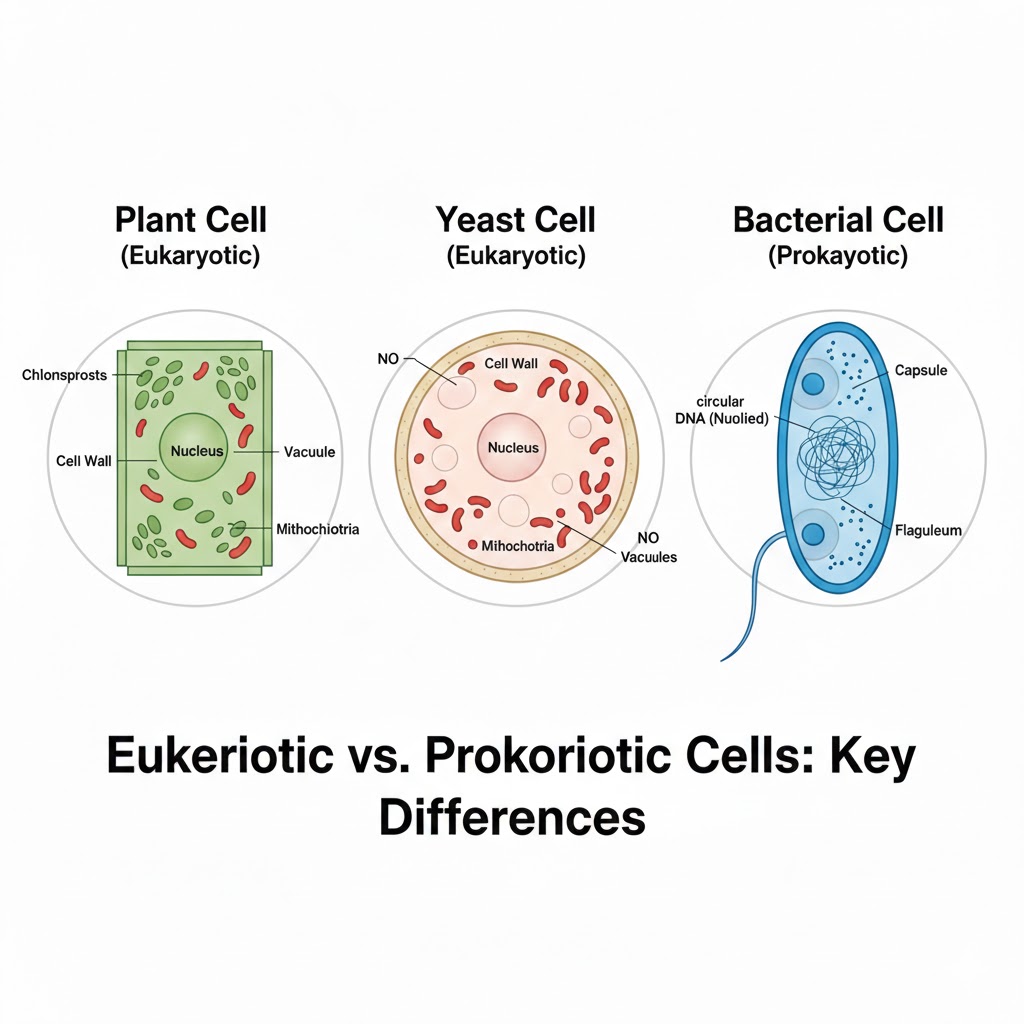
Plants and yeast are eukaryotic organisms, meaning their genetic material (DNA) is safely enclosed within a nuclear membrane. In contrast, bacteria are prokaryotic; they do not have a nucleus, and their DNA floats freely within the cell in a region called the nucleoid.
Why the Presence of a Nucleus Matters?
The nucleus is often called the “brain” of the cell. In plant and yeast cells, it performs several vital functions that bacteria handle differently:
- DNA Protection: It shields genetic material from metabolic byproducts.
- Complex Regulation: It allows for more sophisticated control over how genes are turned on or off.
- Separation of Processes: It separates the reading of DNA (transcription) from the building of proteins (translation), leading to higher biological complexity.
At a Glance: Plant vs. Yeast vs. Bacterial Cells
While the nucleus is the main differentiator, these cells also differ in size and organelle composition. This comparison table highlights the key structural differences:
| Feature | Plant Cell (Eukaryotic) | Yeast Cell (Eukaryotic) | Bacterial Cell (Prokaryotic) |
|---|---|---|---|
| Nucleus | Present | Present | Absent |
| Mitochondria | Present | Present | Absent |
| Cell Wall | Yes (Cellulose) | Yes (Chitin) | Yes (Peptidoglycan) |
| Chloroplasts | Present | Absent | Absent |
| Average Size | 10 – 100 µm | 3 – 10 µm | 0.1 – 5 µm |
Why This Matters for Your Home & Garden?
At Hello Magazine UK, we focus on the practical side of home care. Knowing the difference between these cells is actually very useful for gardeners and homeowners:
- Garden Disease Management: Many organic treatments target peptidoglycan (found only in bacterial cell walls). Because your plants have cellulose walls and a nucleus, these treatments can kill harmful bacteria without damaging your flowers.
- Composting Science: Composting relies on bacteria (prokaryotes) to break down soft green waste, while yeast and fungi (eukaryotes) tackle tougher, woody materials.
- Kitchen Fermentation: Yeast is a hardy eukaryotic cell, which is why it behaves differently than the bacteria that cause food spoilage.
1. Membrane-Bound Organelles
Beyond the nucleus, plant and yeast cells contain other specialized compartments called organelles, such as mitochondria (for energy) and the endoplasmic reticulum. Bacterial cells lack these internal compartments, performing all their life functions directly in the cytoplasm.
2. Cell Wall Composition
Interestingly, all three have cell walls, but they are made of different materials. In your garden, plant walls are made of cellulose. The yeast used in baking has walls made of chitin. Bacteria use a unique material called peptidoglycan, which is why many antibiotics can kill bacteria without harming your plants or yeast.
3. Chloroplasts: The Plant Exclusive
While plants and yeast share a nucleus, they are not identical. Chloroplasts (used for photosynthesis) are found in plant cells but are entirely absent in both yeast and bacterial cells.
Conclusion
To summarize, the nucleus is the defining structure present in plant and yeast cells but missing from bacteria. This microscopic difference explains why eukaryotes are capable of forming complex life like the trees in your garden or the yeast in your bread, while prokaryotic bacteria remain simple and single-celled.
Frequently Asked Questions
1. Do yeast cells have chloroplasts like plant cells?
No. While both are eukaryotes, yeast cells do not perform photosynthesis and therefore do not have chloroplasts. They get their energy from organic compounds (like sugar).
2. Why don’t bacterial cells have a nucleus?
Bacteria are prokaryotes, which are evolutionary older and simpler. Their DNA is organized into a single circular chromosome that stays in the cytoplasm for faster replication.
3. Is a cell wall the same as a nucleus?
No. A cell wall is the outer protective layer, while the nucleus is an internal organelle that holds DNA. Bacteria have cell walls but lack the nucleus.

Home Diagnostics and Technical Standards Specialist at Hello Mag. She provides high-level Expertise in appliance mechanics and scientific pest management, ensuring every guide follows strict safety protocols and manufacturer standards. As a leading Authority on technical home specs, Kanimozhi audits complex data to provide homeowners with the most accurate, verified, and reliable diagnostic solutions available.
0 Comments