
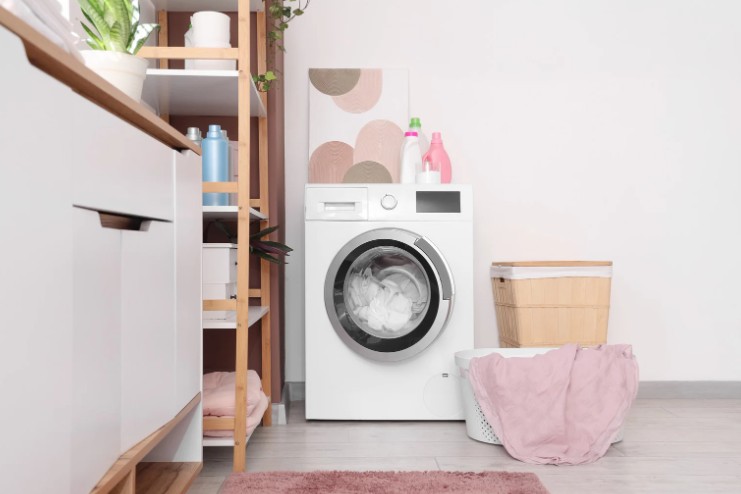
- Quick Reference: Standard UK Washing Machine Dimensions
- Is There A "Standard" Size For UK Washing Machines?
- Why Does Washing Machine Depth Vary So Much?
- Do Larger Capacity Machines (10kg+) Need More Space?
- What Is The Difference Between Freestanding And Integrated Sizes?
- How Much Extra Clearance Do You Really Need For Hoses And Pipes?
- Can You Fit A Modern Machine Into An Older Kitchen Gap?
- Step-By-Step DIY: How Do You Measure Your Space Like A Professional?
- Conclusion: The First-Time Buyer’s Checklist
- What are the FAQ about Are all washing machines the same size?
If you are a first-time homebuyer or a DIY enthusiast planning a kitchen refresh, you might assume that buying a new washing machine is as simple as picking a brand and hitting ‘buy’.
After all, most kitchen gaps look roughly the same. However, the short answer to “are all washing machines the same size?” is a resounding no.
While the industry follows certain “standard” benchmarks, a variation of just 10mm can be the difference between a seamless installation and an expensive appliance sitting in the middle of your hallway because it won’t fit the gap.
In this guide, we will break down everything you need to know about dimensions, hidden clearances, and the DIY pitfalls to avoid.
Quick Reference: Standard UK Washing Machine Dimensions
Before we dive into the technical details, use this comparison table to understand the typical footprints of different machine types found in the UK market.
| Machine Type | Standard Width | Standard Height | Typical Depth | Ideal For |
|---|---|---|---|---|
| Freestanding | 60cm | 85cm | 50cm – 65cm | Most UK Kitchens & Utility Rooms |
| Integrated (Built-in) | 59.5cm – 60cm | 82cm | 54cm – 56cm | Seamless Kitchen Designs (behind a door) |
| Slimline | 60cm | 85cm | 40cm – 45cm | Shallow Units or Small Flats |
| Large Capacity (10kg+) | 60cm | 85cm | 60cm – 70cm | Large Families / Heavy Loads |
Is There A “Standard” Size For UK Washing Machines?
In the UK, the “standard” width for a washing machine is 60cm. This is designed to match the standard width of kitchen units and worktop configurations.
The standard height is generally 85cm, which allows the machine to slide under a standard-height worktop (usually set at 90cm including the worktop thickness).
However, “standard” is a loose term. While width and height are relatively consistent to fit the architecture of British kitchens, depth is the wild card. Depending on the drum size and the design of the door, the depth can fluctuate significantly.
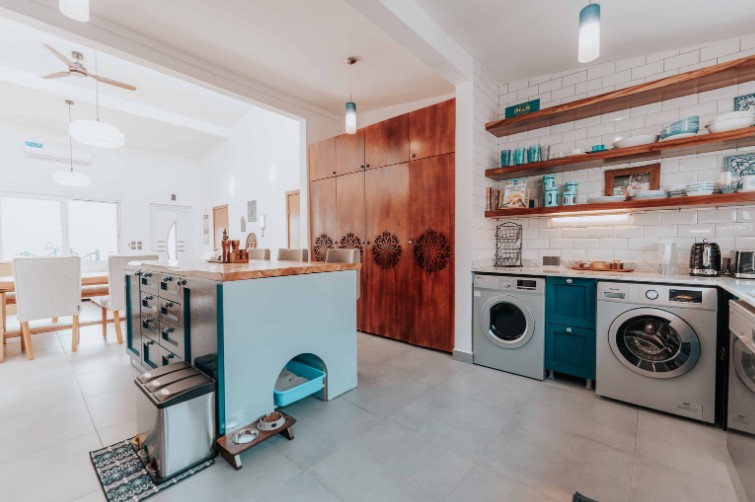
Why Does Washing Machine Depth Vary So Much?
As a first-time buyer, you might notice two machines that look identical from the front but have vastly different price tags and specs. Often, this is down to the drum capacity.
A machine with a 7kg drum is physically shallower than one with a 12kg drum. Manufacturers increase the depth of the machine to accommodate a larger internal cylinder.
If you are a DIYer retrofitting a machine into an older kitchen, you must be careful; modern “A-rated” energy machines often have deeper drums and more insulation, meaning they may stick out further than the machine you are replacing.
Do Larger Capacity Machines (10kg+) Need More Space?
A common misconception is that a 10kg machine must be wider than a 7kg machine. In reality, they are almost always 60cm wide. The extra volume is found by making the machine deeper.
If you are opting for a high-capacity machine, you must measure the “full depth.” This includes the curvature of the front door and the control knobs. A “60cm deep” machine on a spec sheet often measures 64cm once you include the door handle.
What Is The Difference Between Freestanding And Integrated Sizes?
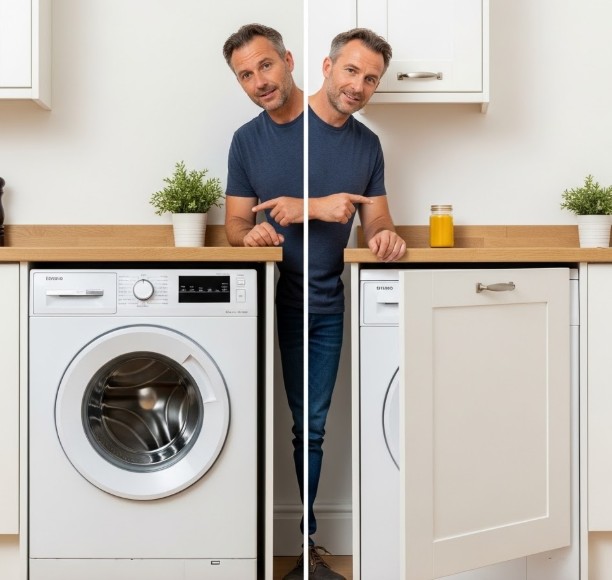
If you want your kitchen to have a sleek, uniform look, you might be looking at integrated washing machines. These are designed to sit behind a cupboard door.
- Height: Integrated machines are slightly shorter (usually 82cm) because they sit on the floor but need to clear the underside of the cabinet frame and the “plinth” (the wooden board at the bottom of your kitchen units).
- Depth: They are significantly shallower (approx. 55cm) to allow room for the cupboard door to close flush with the rest of your kitchen.
- DIY Tip: You cannot easily put a freestanding machine into an integrated gap. Freestanding machines are too tall and their vibration profile is different, which could cause your kitchen units to rattle or damage the cupboard door.
How Much Extra Clearance Do You Really Need For Hoses And Pipes?
This is where most DIY enthusiasts get caught out. If your gap is 60cm deep and your machine is 60cm deep, it will not fit.
You must account for:
- The Plumbing (5-7cm): The cold water fill hose, the waste-water standpipe, and the power cable all sit behind the machine. If you push the machine flush against the wall, you risk kinking the hoses, which leads to drainage errors or floods.
- Vibration Gap (0.5cm each side): Washing machines spin at up to 1,600 RPM. They need a tiny bit of “breathing room” so they don’t bang against your kitchen cabinets during the spin cycle.
Can You Fit A Modern Machine Into An Older Kitchen Gap?
For those moving into an older property, you might encounter two specific issues:
1. The “Countertop Sag”
Over time, heavy laminate or wooden worktops can sag in the middle. If your gap was exactly 85cm twenty years ago, it might be 84.5cm today. Always measure the height at the left, centre, and right of the gap.
2. Flooring Changes
If you have recently laid luxury vinyl tiles (LVT) or laminate over an old floor, you have raised the floor level. This reduces the height of your appliance gap. Ensure you measure from the finished floor to the underside of the worktop.
Step-By-Step DIY: How Do You Measure Your Space Like A Professional?
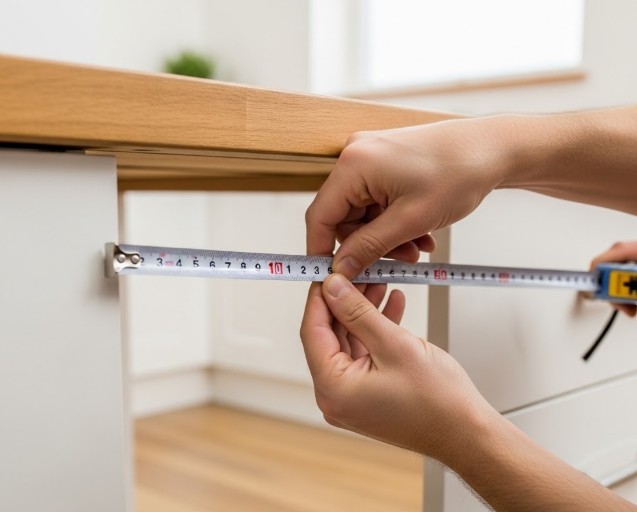
- Measure the Width: Take measurements at the top and the bottom of the gap. Walls are rarely perfectly straight. Use the smallest measurement.
- Measure the Height: Measure from the floor to the lowest point of the worktop. If the floor is uneven, check multiple spots.
- Measure the Depth: Measure from the back wall (or the pipes) to the front of the cabinets.
- Check the “Swing”: Ensure there is enough room for the machine door to open fully without hitting a wall or a radiator.
Conclusion: The First-Time Buyer’s Checklist
To ensure your first appliance purchase isn’t a headache, remember these three golden rules:
- Don’t trust the “Standard”: Always pull out the tape measure yourself.
- Factor in the Pipes: Add 7cm to the depth of the machine for a safe installation.
- Check the Type: Ensure you aren’t buying an integrated machine for a freestanding gap, or vice versa.
By following this guide, you’ll ensure your new washing machine fits perfectly, runs quietly, and lasts for years to come.
What are the FAQ about Are all washing machines the same size?
1. Will a washing machine fit in a car?
Most standard washing machines will fit in a medium-sized hatchback (like a VW Golf or Ford Focus) if the back seats are folded flat. However, you must keep it upright to avoid damaging the internal suspension springs.
2. How wide is a slimline washing machine?
Interestingly, “slimline” usually refers to depth, not width. A slimline washer is still 60cm wide but only 40cm to 45cm deep, making it ideal for shallow kitchen units.
3. Can I adjust the height of my washing machine?
Yes. Almost all machines have “levelling feet.” These can usually be screwed in or out to adjust the height by about 1cm to 2cm, helping you level the machine on uneven floors.

Home Diagnostics and Technical Standards Specialist at Hello Mag. She provides high-level Expertise in appliance mechanics and scientific pest management, ensuring every guide follows strict safety protocols and manufacturer standards. As a leading Authority on technical home specs, Kanimozhi audits complex data to provide homeowners with the most accurate, verified, and reliable diagnostic solutions available.
0 Comments