Are you looking for how to get rid of mushrooms in lawn and need to stop them from growing? Mushrooms growing in your lawn can be an eyesore, and while they don’t harm your grass, they often indicate deeper lawn problems such as excessive moisture, decaying organic matter, or compacted soil.
If you’re struggling with unwanted mushrooms in your garden, this guide will help you understand why they appear and how to remove them effectively.
By following the right methods, you can stop mushrooms from growing and maintain a healthier, fungus-free lawn.
Why Are Mushrooms Growing in My Garden?
Mushrooms grow in lawns and gardens due to specific conditions that favour fungal growth. These conditions include excess moisture, decomposing organic matter, compacted soil, and limited sunlight.
What are the Common Reasons Mushrooms Appear in Lawns?
Excess Moisture – Overwatering, poor drainage, and damp weather create the perfect environment for mushrooms.
Organic Matter Decay – Decomposing tree roots, leaves, mulch, and grass clippings act as food sources for fungi.
Compacted Soil – Hard, dense soil prevents proper air circulation and traps moisture, allowing mushrooms to thrive.
Low Sunlight Areas – Mushrooms prefer shaded, damp environments, making heavily shaded areas more prone to fungal growth.
Soil pH Imbalance – Acidic or nutrient-deficient soil can promote mushroom growth.
Understanding these causes helps in applying the right solutions to remove mushrooms and prevent their return.
How to Get Rid of Mushrooms in Lawn? – 5 Effective Ways
1. Remove Mushrooms by Hand
The fastest way to eliminate mushrooms is to remove them manually before they release spores.
How to Remove Mushrooms by Hand?
Wear gloves to avoid direct contact.
Pick the mushrooms carefully, ensuring you remove them at the base.
Place the mushrooms in a sealed bag and dispose of them in the bin.
Rake the affected area to disturb any hidden fungal spores.
Picking mushrooms early in the morning before they mature prevents them from spreading spores and growing back.
2. Improve Lawn Drainage
Poor drainage and excess moisture are the main reasons for mushroom growth. Improving your lawn’s drainage will reduce damp conditions that encourage fungi.
How to Improve Lawn Drainage?
Aerate the lawn using a garden fork or aeration tool to allow better water absorption.
Level any low spots where water collects after rainfall.
Water the lawn in the morning instead of the evening to allow excess moisture to evaporate.
Use sand or compost to improve soil structure and drainage.
A well-drained lawn discourages mushroom growth by preventing excess moisture buildup.
3. Use a Natural Fungicide
Natural solutions can help kill mushrooms without harming your grass.
What Are The Best Natural Fungicides for Mushrooms?
Baking Soda Solution: Mix two tablespoons of baking soda with one gallon of water and spray over mushrooms. This alters the soil’s pH and inhibits fungal growth.
Dish Soap Spray: Mix a few drops of dish soap with water and spray directly onto mushrooms to break down their structure.
White Vinegar Mix: A diluted solution of white vinegar can be used as a natural fungicide, but it must be applied carefully to avoid harming nearby grass.
Applying these treatments regularly will help eliminate mushrooms and stop them from spreading.
4. Apply Commercial Lawn Fungicide
For severe mushroom infestations, a store-bought fungicide may be necessary.
How to Choose and Use a Lawn Fungicide?
Select a fungicide labelled for mushroom control and safe for grass.
Opt for pet-safe and eco-friendly options to protect your lawn and environment.
Apply fungicide according to the manufacturer’s instructions for the best results.
Fungicides are effective for stopping mushroom growth but should be combined with lawn maintenance practices for long-term prevention.
5. Reduce Organic Debris in Lawn
Decaying organic matter provides nutrients for fungi, so keeping your lawn clean can prevent mushroom growth.
How to Remove Organic Debris from Your Lawn?
Rake up fallen leaves and remove excess grass clippings.
Remove old tree stumps and decomposing wood from the lawn.
Regularly dethatch your lawn to prevent organic buildup.
Keeping your lawn free from decaying plant material will eliminate the food source that mushrooms rely on.
How to Stop Mushrooms Growing in Garden?
Preventing mushrooms from reappearing involves improving overall lawn health and maintaining good garden practices.
What are the Key Prevention Methods?
Aerate the soil regularly to improve drainage and reduce fungal growth.
Increase sunlight exposure by trimming trees or bushes that create excessive shade.
Balance soil pH levels by adding lime if your soil is too acidic.
Dethatch the lawn to remove organic matter that encourages fungal growth.
Apply a preventative fungicide if mushrooms have been a recurring issue.
By making these changes, you can create an environment that is less favourable for mushrooms to grow.
Are Lawn Mushrooms Poisonous in the UK?
Most lawn mushrooms in the UK are harmless, but some can be toxic, especially to pets and children.
What are Common Poisonous Lawn Mushrooms in the UK?
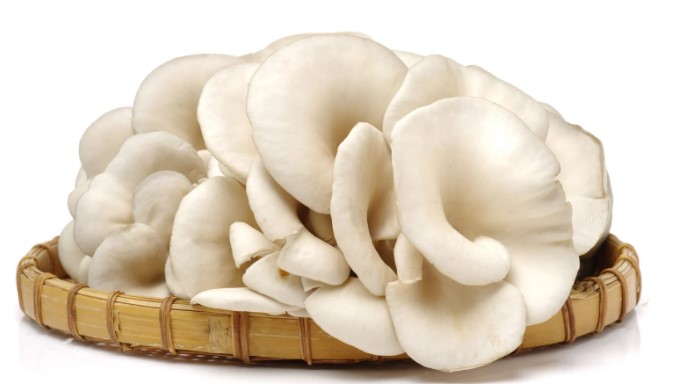
Fly Agaric (Amanita muscaria) – Red cap with white spots, highly toxic.
Death Cap (Amanita phalloides) – Extremely poisonous and can be deadly if ingested.
Fool’s Funnel (Clitocybe rivulosa) – Small white mushrooms that can be harmful to pets.
If you are unsure about a mushroom in your lawn, avoid touching or consuming it and consult an expert.
How to Kill Mushrooms in Lawn?
The best way to kill mushrooms is to remove them manually, improve lawn drainage, and apply natural or chemical fungicides.
What are Fastest Methods to Kill Mushrooms?
Hand-pick and dispose of mushrooms immediately.
Apply baking soda, dish soap spray, or vinegar to affected areas.
Improve drainage and aeration to stop future growth.
Use a store-bought fungicide if mushrooms keep returning.
Combining these methods will help you eliminate mushrooms and prevent new ones from growing.
Conclusion
Mushrooms in your lawn are a sign of moisture and organic decay, and while they are not directly harmful to grass, they can be unsightly and sometimes toxic.
The best way to remove mushrooms is by improving drainage, manually removing them, applying natural treatments, and maintaining proper lawn care.
By following these steps on how to get rid of mushrooms in lawn, you can eliminate mushrooms and keep your garden healthy and fungus-free.
Common Questions on Mushrooms in Lawn
1. Are Mushrooms in Lawn a Problem?
Mushrooms do not harm grass, but they indicate excess moisture and organic decay, which can affect lawn health. They can also be toxic to pets and children, making removal important.
2. What Type of Mushrooms Are Growing in My Lawn?
The most common lawn mushrooms in the UK include Fairy Ring Mushrooms, Ink Cap Mushrooms, and Parasol Mushrooms. Some are harmless, while others can be toxic.
3. Are the Mushrooms in My Lawn Poisonous to Dogs?
Some mushrooms, such as Death Cap and Fool’s Funnel, are highly toxic to dogs. If your dog ingests a wild mushroom, seek veterinary attention immediately.
4. How Do You Get Rid of Fungus in Your Lawn?
To remove fungus from your lawn:
Improve drainage by aerating the soil.
Apply natural fungicides like baking soda or dish soap spray.
Home Diagnostics and Technical Standards Specialist at Hello Mag. She provides high-level Expertise in appliance mechanics and scientific pest management, ensuring every guide follows strict safety protocols and manufacturer standards. As a leading Authority on technical home specs, Kanimozhi audits complex data to provide homeowners with the most accurate, verified, and reliable diagnostic solutions available.
Fruit flies are tiny but incredibly annoying pests that invade kitchens, hover around fruits, and seem impossible to get rid of.
Many people use apple cider vinegar traps, but what if you don’t have it or prefer not to use it? Here is how to get rid of fruit flies without apple cider vinegar.
The good news is that you don’t need apple cider vinegar to eliminate fruit flies. In this guide, I’ll share the most effective, natural, and DIY methods on how to remove fruit flies from your home. Whether you want homemade traps, repellents, or long-term prevention, this guide has you covered.
What Attracts Fruit Flies to Your Home?
Before tackling the problem, it’s important to understand why fruit flies invade your home in the first place. These tiny pests reproduce rapidly, with a single female laying up to 500 eggs at a time.
What are the Common Reasons You Have Fruit Flies?
Overripe or rotting fruits & vegetables – Their favourite breeding ground.
Sugary liquids & spills – Fruit juice, soda, wine, or beer attract them.
Dirty drains & sinks – The damp environment allows them to thrive.
Moist, damp areas – Bathrooms, mops, sponges, and standing water help them multiply.
Now that you know what’s attracting them, let’s explore the best ways to get rid of them—without apple cider vinegar.
5 Effective Ways on How To Get Rid of Fruit Flies Without Apple Cider Vinegar
Dish Soap and Sugar Water Trap
Why It Works?
Fruit flies are attracted to sugar, and dish soap breaks the surface tension, causing them to drown.
What You Need?
A small bowl or cup
Warm water
1-2 teaspoons of sugar
A few drops of dish soap
How to Make It?
Fill a small bowl with warm water and mix in the sugar.
Add a few drops of dish soap and stir.
Leave it near areas with fruit flies—they’ll be drawn in and trapped.
Change the mixture every 1-2 days for the best results.
Lemon and Clove Repellent
Why It Works?
The strong scent of cloves and citrus oils repels fruit flies naturally. Usually, files do like few smell and the lemon and clove stands out from them.
What You Need?
1 fresh lemon
10-15 whole cloves
How to Make It?
Cut a lemon in half.
Stick whole cloves into the flesh of the lemon.
Place it in problem areas such as kitchen counters or near trash bins.
Replace the lemon every 5-7 days for long-lasting results.
Milk, Sugar, and Black Pepper Trap
Why It Works?
The sweet milk attracts fruit flies, while pepper irritates them, causing them to drown.
What You Need?
1 cup of milk
3 tablespoons of sugar
1 tablespoon of black pepper
How to Make It?
Heat the milk in a saucepan and mix in the sugar and pepper.
Pour the mixture into a shallow dish.
Leave it near fruit fly hotspots.
This method is great for catching large numbers of fruit flies overnight.
White Vinegar and Dish Soap Trap
Why It Works?
White vinegar has a strong scent that attracts fruit flies, while dish soap traps them.
What You Need?
A small bowl
White vinegar
Dish soap
How to Make It?
Fill a bowl with white vinegar.
Add a few drops of dish soap and stir.
Place it where fruit flies gather.
If you don’t have vinegar, you can use fermented fruit juice instead.
Essential Oils to Repel Fruit Flies
Why It Works?
Essential oils disrupt fruit flies’ scent receptors, making them avoid your home.
Best Essential Oils for Fruit Flies?
Peppermint oil
Lavender oil
Eucalyptus oil
Tea tree oil
How to Use It?
Mix 10-15 drops of essential oil with water in a spray bottle.
Spray near windows, fruit bowls, and kitchen surfaces.
Alternatively, soak cotton balls in essential oil and leave them near fruit fly hotspots.
How to Prevent Fruit Flies from Coming Back?
Getting rid of fruit flies is one thing, but keeping them away is even more important.
Prevention Tip
Why It Works
Store Fruits Properly
Keep fruits in the fridge or in sealed containers.
Clean Up Spills Immediately
Sugary spills attract fruit flies within hours.
Take Out Rubbish Daily
Unsealed trash bins breed fruit flies quickly.
Rinse and Dry Drains
Pour boiling water down the drain to kill larvae.
Use Sticky Fly Traps
Catch lingering fruit flies before they reproduce.
Conclusion
Fruit flies can be stubborn, but you don’t need apple cider vinegar to get rid of them. By using dish soap traps, lemon repellents, milk traps, white vinegar, and essential oils, as mentioned in this guide on how to get rid of fruit flies without apple cider vinegar, you can eliminate fruit flies quickly and naturally.
Prevention is key. Keep your kitchen clean, store fruits properly, and seal your rubbish bins to keep fruit flies away for good.
Tried any of these methods? Share your experience in the comments!
FAQs About Fruit Flies
1. Can Fruit Flies Come from Drains?
Yes, fruit flies lay eggs in moist drains. Clean them with boiling water and baking soda to prevent infestations.
2. Do Fruit Flies Bite?
No, fruit flies do not bite, but they can contaminate food.
3. How Long Does It Take to Get Rid of Fruit Flies?
With proper traps and prevention, you can eliminate them in 2-3 days.
Home Diagnostics and Technical Standards Specialist at Hello Mag. She provides high-level Expertise in appliance mechanics and scientific pest management, ensuring every guide follows strict safety protocols and manufacturer standards. As a leading Authority on technical home specs, Kanimozhi audits complex data to provide homeowners with the most accurate, verified, and reliable diagnostic solutions available.
In physics, the concept of work done is fundamental to understanding energy transfer. Work is done when a force is applied to an object, resulting in movement.
The amount of work done depends on the force applied, the distance moved, and the direction of force relative to displacement.
In this guide, I’ll walk you through the calculation for how much work is done if a force of 20N is used to move an object 6 metres? I’ll also explain the factors that influence work, its SI units, and real-life examples.
Let’s dive in!
What Is the Formula for Work Done in Physics?
In physics, work (W) is defined as the product of force and displacement in the direction of the applied force. Mathematically, it is given by:
W = F × d × cos(θ)
Where:
W = Work done (Joules, J)
F = Applied force (Newtons, N)
d = Displacement (Metres, m)
θ = Angle between force and displacement (Degrees)
The cos(θ) component accounts for the direction of force relative to displacement. If the force is applied in the same direction as movement, θ = 0°, and cos(0) = 1, simplifying the formula to:
W = F × d
How Much Work Is Done If a Force of 20N Is Used to Move an Object 6 Metres?
Now, let’s apply the formula to the given values:
Force (F) = 20 N
Displacement (d) = 6 m
Angle (θ) = 0° (force and displacement are in the same direction)
Using the formula:
W=20×6×cos(0)
W=20×6×1
W=120 Joules (J)
So, the total work done is 120 Joules (J).
What Are the SI Units of Work?
In physics, the SI unit of work is the Joule (J). One Joule is defined as:
“The work done when a force of 1 Newton moves an object by 1 metre in the direction of the force.”
Other common units used in different contexts include:
Unit
Equivalent in Joules
Used In
Joule (J)
1 J
General physics calculations
Kilojoule (kJ)
1,000 J
Energy measurements in food, engineering
Foot-pound (ft-lb)
1.356 J
Mechanical work, torque
Erg
10−710^{-7}10−7 J
Small-scale physics experiments
What Factors Affect the Amount of Work Done?
Several factors influence the amount of work done:
Force Applied (F) – A greater force results in more work being done.
Displacement (d) – The farther the object moves, the more work is performed.
Angle Between Force and Displacement (θ) –
If force and displacement are in the same direction (θ = 0°), work is maximised.
If force is perpendicular to displacement (θ = 90°), no work is done (e.g., carrying a book without moving it horizontally).
If force is opposite to displacement (θ = 180°), work is negative (e.g., friction slowing an object down).
What Are The Real-Life Examples of Work Done in Physics?
Work done is a concept we see in everyday life. Here are a few examples:
Lifting a grocery bag – Work is done against gravity when lifting a bag.
Pushing a shopping trolley – Work is done when force moves the trolley forward.
Cycling on a road – Leg muscles apply force to move the bicycle.
Throwing a ball – Work is done to give the ball kinetic energy.
The table below highlights different scenarios of work done:
Scenario
Force Applied
Distance Covered
Work Done?
Pushing a car
High
Significant
Yes
Carrying a box while walking
High
None (no displacement in force direction)
No
Lifting weights
Medium
Small
Yes
Holding a book steady
Medium
None
No
What are the Common Misconceptions About Work in Physics?
Many people misunderstand the concept of work in physics. Here are a few common misconceptions:
“If I push an object and it doesn’t move, work is still done.” No, work requires both force and displacement. If the object doesn’t move, no work is done.
“Work and energy are the same thing.” Work is energy transfer, not energy itself. Energy is the ability to do work.
“Holding a heavy object in place requires work.” No, if there’s no movement, no work is done, even if force is applied.
Conclusion
Understanding work in physics helps explain how force and displacement interact. In our example, the question is how much work is done if a force of 20N is used to move an object 6 metres? and we have the answer as when a force of 20N moves an object 6 metres, 120 Joules of work is done.
Key takeaways:
Work is force multiplied by displacement in the force’s direction.
SI unit of work is the Joule (J).
No movement = no work, even if force is applied.
Work depends on force, distance, and angle between them.
By applying these principles, we can better understand mechanics, engineering, and energy transfer in everyday life.
Home Diagnostics and Technical Standards Specialist at Hello Mag. She provides high-level Expertise in appliance mechanics and scientific pest management, ensuring every guide follows strict safety protocols and manufacturer standards. As a leading Authority on technical home specs, Kanimozhi audits complex data to provide homeowners with the most accurate, verified, and reliable diagnostic solutions available.
In physics, work and time are two crucial factors that define how energy is transferred. When work is done, energy is used or transferred from one form to another. But what name is given to the amount of work done in a given time? That’s where the concept of Power comes in.
Power plays a fundamental role in physics, engineering, and even our daily lives. From measuring the performance of machines to understanding energy consumption in appliances, power helps us quantify how quickly work is performed.
In this guide, I’ll explain what power is, how it is calculated, its SI units, and its real-world applications. Let’s dive in!
What Name Is Given to the Amount of Work Done in a Given Time?
The correct term for the amount of work done in a given time is Power.
In simple terms, Power is the rate at which work is done. It tells us how quickly energy is transferred or how fast a task is completed in a specific period.
For example:
A 100-watt light bulb consumes energy faster than a 40-watt bulb.
A sports car accelerates faster than a truck because it has higher power.
Power is a key concept in mechanics, electrical systems, and thermodynamics, helping us understand efficiency and performance.
How Is Power Related to Work and Time?
Power is mathematically defined as:
Power(P) = WorkDone(W) / TimeTaken(t)
Where:
P is power (measured in Watts, W)
W is work done (measured in Joules, J)
t is time taken (measured in seconds, s)
This formula shows that the faster work is done, the higher the power.
Example Calculation:
Imagine lifting a 10 kg object to a height of 2 meters in 4 seconds.
Work done = Force × Distance = (10 × 9.8) × 2 = 196 Joules
Power = 196 J / 4 s = 49 Watts
Thus, the power required for this task is 49 W.
What Are the SI Units of Power?
Power is measured in Watts (W), named after James Watt, the inventor of the steam engine.
Unit Conversions:
1 Watt (W) = 1 Joule per second (J/s)
1 Kilowatt (kW) = 1,000 Watts
1 Horsepower (hp) ≈ 746 Watts
Other Units of Power:
Unit
Equivalent in Watts
Used In
Watt (W)
1 W
General science & physics
Kilowatt (kW)
1,000 W
Electrical appliances
Horsepower (hp)
746 W
Automobiles & engines
Megawatt (MW)
1,000,000 W
Power plants & industry
What Are Some Real-Life Applications of Power?
Power is an essential concept used in various fields. Some common applications include:
Electrical Appliances – Light bulbs, televisions, and refrigerators consume electrical power measured in watts.
Vehicles and Engines – Horsepower (hp) is used to measure the performance of cars and motorcycles.
Sports and Athletics – Power is a key factor in sprinting, weightlifting, and other high-energy activities.
Construction and Engineering – Machines like cranes and bulldozers use power to perform heavy tasks.
How Does Power Differ from Energy and Work?
Many people confuse power with energy and work. Here’s a simple comparison:
Concept
Definition
SI Unit
Formula
Work
Energy transferred when force is applied over a distance
Joule (J)
W = F × d
Energy
The capacity to do work
Joule (J)
E = P × t
Power
Rate at which work is done
Watt (W)
P = W / t
Key takeaway:
Work and energy measure how much effort is exerted.
Power measures how fast that effort is applied.
What are the Common Misconceptions About Power and Work?
There are several misunderstandings about power and work, such as:
Power is not the same as energy – Energy is the capacity to do work, while power is the rate at which that work is done.
More power doesn’t always mean more energy consumption – A high-power device may run for a shorter time, consuming less energy overall.
Watt and horsepower are not interchangeable – Horsepower is used for engines, while watt is used for electrical power.
Conclusion
Power is a fundamental concept in physics, defining the rate at which work is done. Understanding power, its units, and applications helps us analyze mechanical and electrical systems efficiently.
From vehicles to household appliances,power plays a vital role in our everyday lives. By knowing how to measure and interpret power, we can make smarter decisions about energy usage and efficiency.
Home Diagnostics and Technical Standards Specialist at Hello Mag. She provides high-level Expertise in appliance mechanics and scientific pest management, ensuring every guide follows strict safety protocols and manufacturer standards. As a leading Authority on technical home specs, Kanimozhi audits complex data to provide homeowners with the most accurate, verified, and reliable diagnostic solutions available.
Updated on: March 26, 2026 | Verified for UK Bosch Serie 4, 6, 8, and Logixx Models
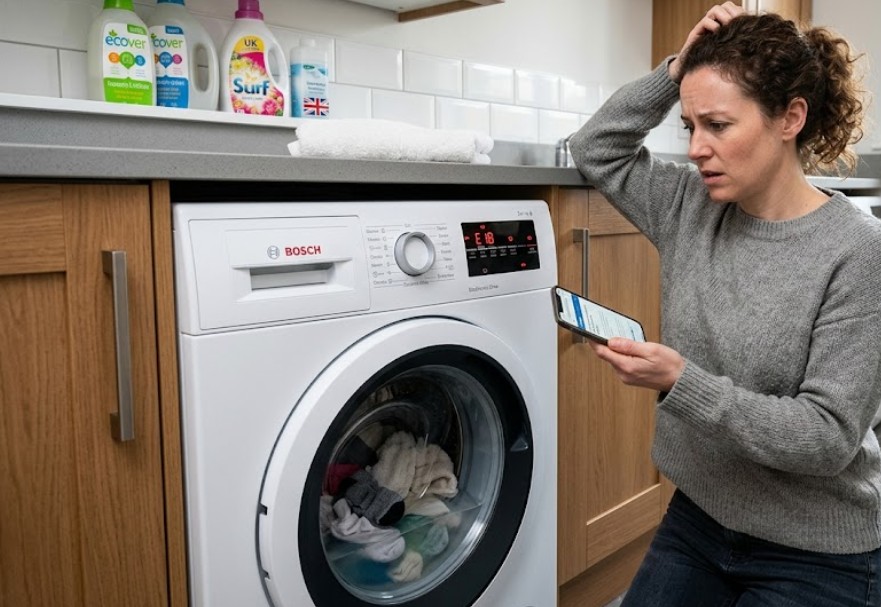
I’ve spent over a decade diagnosing appliance faults, and I can tell you that seeing the Bosch Washing Machine E18 code display usually happens at the worst possible time—usually when the machine is full of soggy clothes and the floor is at risk of flooding.
The good news? In 90% of cases, you don’t need to pay a call-out fee to an engineer. You can fix this yourself in under 20 minutes if you follow the right sequence.
The Short Answer
How to Fix Bosch Washing Machine E18 Error Instantly
The Bosch E18 error indicates a drainage timeout. Follow these three steps to clear it in under 20 minutes:
1. Power Down: Turn the dial to ‘Off’ and pull the plug from the mains socket.
2. Drain Safely: Open the bottom-right flap, use the emergency black hose to empty the water into a shallow tray.
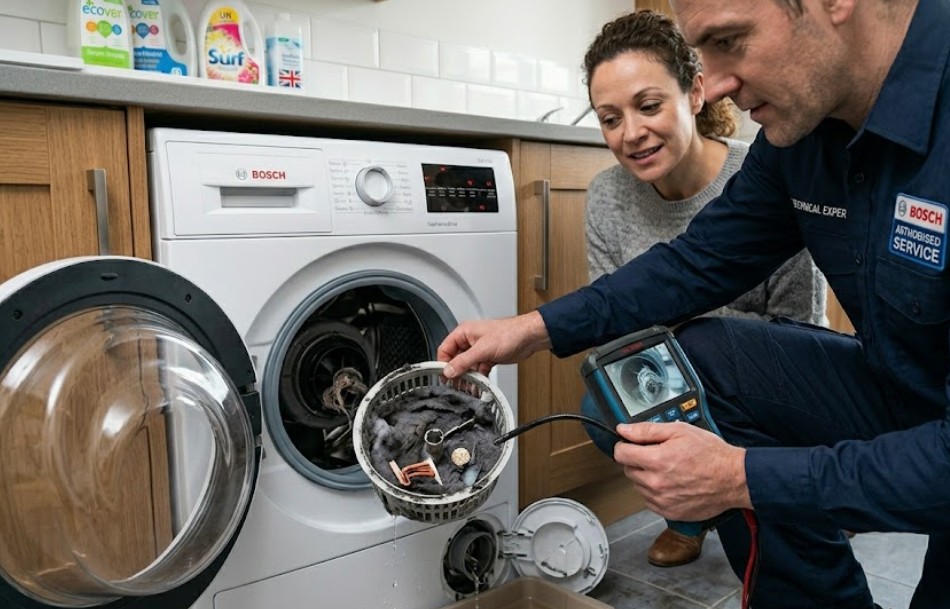
3. Clear Blockages: Unscrew the circular pump filter and remove any debris (coins, lint, or hairpins) from the filter and internal impeller.
Expert Tip: If the filter is stuck, use a hairdryer on warm heat for 2 minutes to soften UK limescale buildup before twisting.
What Does The Bosch E18 Error Code Actually Mean?
In technical terms, the E18 (or F18 on some models) is a “drain time-out” fault. Your Bosch’s brain (the control module) has told the pump to empty the drum, but the internal water level sensor hasn’t detected a drop in water after a set period.
While E18 is the most common drainage fault, it is often confused with other flow issues. Use the table below to ensure you are troubleshooting the right component.
Bosch Error Code Comparison Table
Error Code
Primary Meaning
Most Likely Culprit
DIY Fix Difficulty
E18 / F18
Drainage Fault
Blocked pump filter or kinked waste pipe
Easy (DIY)
E17 / F17
Water Inlet Fault
Tap turned off or blocked inlet filter
Very Easy (DIY)
E23 / F23
Leak Detected
Water in the base tray (AquaStop triggered)
Moderate (Technical)
F03
Drainage Timeout
Faulty pump motor or pressure switch
Hard (Professional)
Why Is My Bosch Washing Machine Showing The E18 Code?
Before we dive into the fix, it’s helpful to know what we’re looking for. Having opened hundreds of these machines, I typically find one of three issues:
A Physical Obstruction: Coins, bra wires, or hairbands jammed in the pump impeller.
Limescale Seizure: Especially common in hard-water areas of the UK (like London and the South East), where the filter cap becomes “welded” shut.
Siphonage Issues: A blockage in the UK-standard 40mm waste pipe or the standpipe under your sink.
How Can I Safely Drain My Bosch Washer Before Fixing The E18 Error?
You cannot unscrew the filter while the drum is full of water, or you will flood your kitchen.
Isolate the Power: Pull the plug from the socket. Never work on a machine with “live” mains power.
Open the Service Flap: This is the circular or rectangular door at the bottom-right of your Bosch Serie 4, 6, or 8.
Use the Emergency Hose: Locate the small black or grey rubber tube.
Pro-Tip #1: The “Baking Tray Hack” Standard bowls are often too tall to fit under the emergency drain hose. I always recommend using a shallow metal baking tray or a lipped oven sheet. It slides right under the machine’s kickplate, allowing you to drain the water in increments without spilling a drop on your flooring.
Step-By-Step Guide: How Do I Clean The Bosch Drain Pump Filter?
Once the water is drained, it’s time to clear the blockage.
Step 1: Unscrew the Pump Cover
Turn the large circular cap anti-clockwise. If it’s stubborn, don’t force it with pliers yet—see my pro-tip below.
Step 2: Clear the Debris
Pull the filter out. You will likely find a “collection” of items. Look specifically for:
Coins and buttons.
Hairpins and bra wires (these often wrap around the impeller).
Lumps of undissolved detergent or “fatbergs” from low-temperature washes.
Step 3: Check the Impeller
Reach your finger into the hole where the filter was. You’ll feel a plastic fan (the impeller). It must spin freely. If it feels “notchy” or won’t move, there is likely a toothpick or small screw jammed behind the blades.
Pro-Tip #2: The “Limescale Seizure” Fix In many UK homes, the pump filter won’t budge because of limescale. If it’s stuck, do not force the plastic handle or it will snap. Instead, use a hairdryer on a medium heat setting to warm the plastic housing for 2 minutes. The heat expands the plastic slightly and softens the limescale, allowing you to twist it open by hand.
What If The Filter Is Clean But The E18 Error Persists?
If you’ve cleaned the filter and checked the impeller, but the E18 code returns, the problem is further down the line.
The “Blow Test”: Pull your waste pipe out of the standpipe (under the sink). Blow into the end of the hose. If you hear bubbles in the drum, the hose is clear. If you feel resistance, there is a blockage (usually a small sock or grey “sludge”) trapped in the sump hose inside the machine.
The Standpipe Connection: If your washer is connected to the sink “spigot,” ensure the plastic blanking plug was removed when the machine was installed. I’ve seen many “new” E18 errors caused by a simple forgotten plug!
How Do I Reset The Bosch Washing Machine After Fixing E18?
Most modern Bosch Serie 6 and Serie 8 machines will auto-reset once they detect the water has drained. However, if the code lingers:
Turn the programme dial to Off.
Wait 30 seconds.
Turn the dial to a Spin/Drain cycle and press Start.
If the door is locked, hold the Start/Reload button for 5 seconds to force a reset.
Summary: Keeping Your Bosch Washer Error-Free
The E18 error is your machine’s way of asking for a bit of maintenance. By clearing the filter and ensuring your waste hoses aren’t kinked against the back wall, you can extend the life of your Bosch for years.
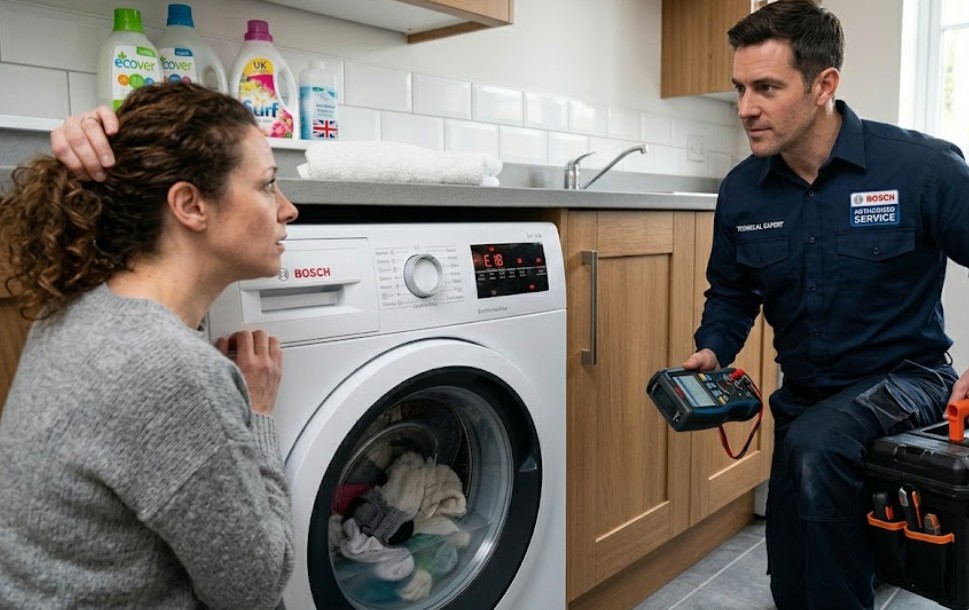
Still seeing the code? If you’ve followed every step and the pump still won’t engage, it may be an electrical failure of the pump motor. At this stage, it’s worth calling a local UK Bosch specialist to test the “continuity” of the pump with a multimeter.
FAQ About “Bosch Washing Machine E18”
1. Can I open the door with an E18 error?
Not while the drum is full. The “Door Lock” is a safety feature to prevent flooding. Once you drain the water via the emergency hose (as described above), the door should click open after a few minutes.
2. How often should I clean my Bosch filter to prevent E18?
If you live in a hard water area of the UK, I recommend cleaning the filter every 3 months. This prevents limescale from seizing the cap and keeps the pump motor from straining.
3. Where can I buy a replacement Bosch pump in the UK?
If the impeller is broken or the motor is humming but not turning, you’ll need a new pump. Retailers like eSpares or BuySpares stock genuine Bosch parts—just ensure you have your “E-Nr” number (found on the inside of the door) to get the right match.
Home Diagnostics and Technical Standards Specialist at Hello Mag. She provides high-level Expertise in appliance mechanics and scientific pest management, ensuring every guide follows strict safety protocols and manufacturer standards. As a leading Authority on technical home specs, Kanimozhi audits complex data to provide homeowners with the most accurate, verified, and reliable diagnostic solutions available.